As presented at the American Association of Physics Teachers Winter Meeting 2026. Written and presented by Megan Hayes-Golding and Jim Perry, Deerfield Academy, Massachusetts
A Live Action Problem is a textbook-type problem solved and tested in a single class meeting. It is not a lab, not a lab practical focused on lab skills. Our class setting is 9th grade Physics at a college preparatory school, taught via Modeling Instruction. The Live Action Problem is generally presented near the end of the unit, as students are practicing model deployment. Links to all our Live Action Problems
Copyright: Except where otherwise attributed to an author, these problems are licensed under a Creative Commons Attribution-NonCommercial-ShareAlike license.
We’ve found lots of success with this structure and these problems. They have high pedagogical value – physics content is at the core and there’s little arts and crafts time. Most of our collision problems draw on prior knowledge (like CA + CV). Students must manage real complications: these buggies aren’t particles and friction exists. The solutions are AI-resistant because they’re completed in a single class. Finally, they build intuition and feel.
To design the Live Action Problem, we write a 2-3 page packet with a clearly written problem, scaffolded questions with space for data or work, result, and % error. It’s important to note that accuracy of the student prediction matters but isn’t everything. Except for time limitations, reassessment can be allowed. However, we’ve had to think about how to avoid students guess-and-checking their way to the correct result.
In solutions, multiple representations are emphasized (such as graphs, descriptions, equations, and sketches).
New problems can be identified three main ways:
- Textbooks
- That’s where the Equilibrium Stations started life
- Collisions
- Wrecking Crew is a CA vs CV collision through a forces lens.
- Stories
- Coyote vs. Road Runner came through an online friend
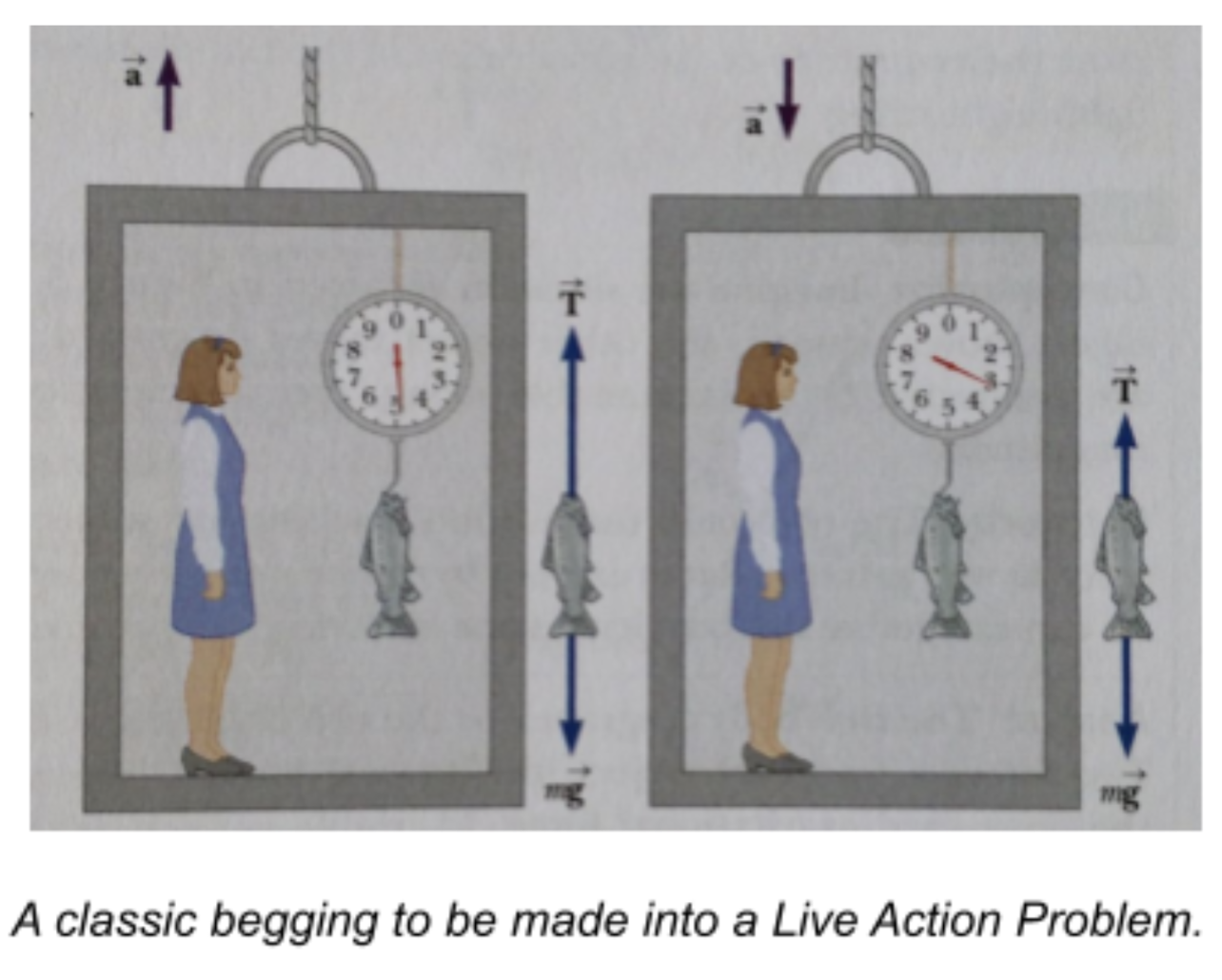
Below, find examples of Live Action Problems Currently in use in our classrooms.
Constant Velocity: Dueling Buggies

Objective: Predict the collision location of two buggies driving towards each other with an initial separation of about 6 meters.
Balanced Forces: Equilibrium Stations
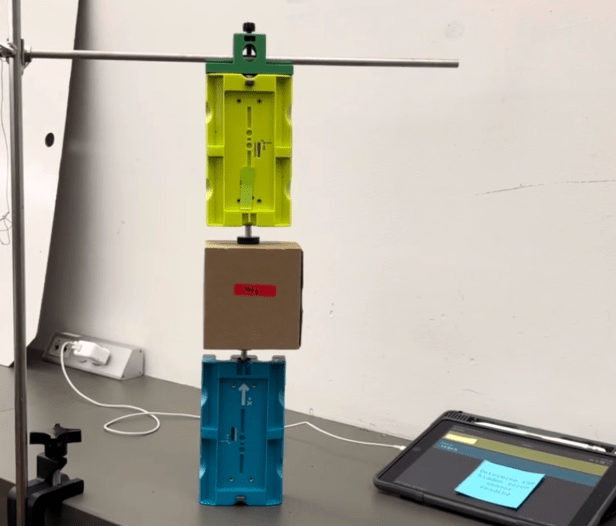
Objective: Visit several stations and solve the live equilibrium problem presented. The problem below says “find the hidden force sensor value.”
The illustrated station was written by Kelly O’Shea, “Problem Solving Lab Stations for Balanced Forces”. Her work was, in turn, inspired by Brian Frank’s, “Challenges and Analogies”.
Constant Acceleration: Coyote vs. Road Runner
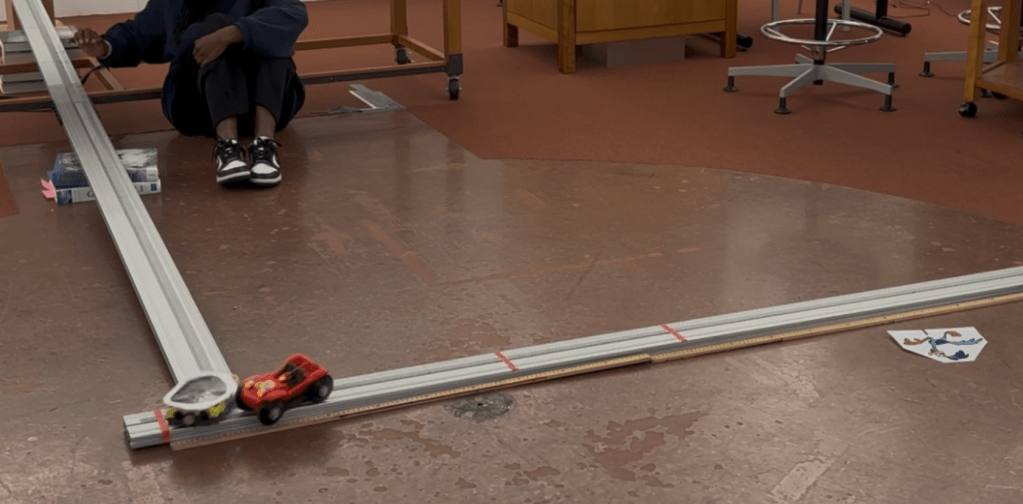
Objective: Help Coyote get Road Runner with a rolling boulder. Red tape on the road marks where Road Runner comes around the corner and into view of Coyote. Students choose the release point for the boulder.
Unbalanced Forces: The Wrecking Crew
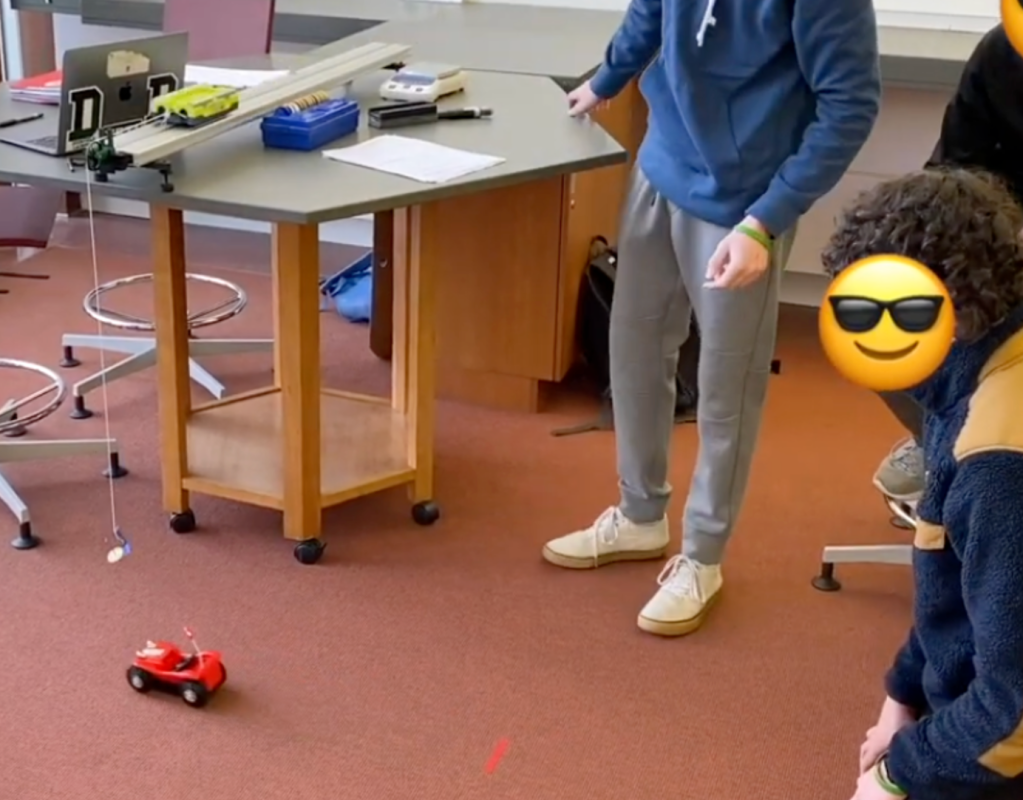
Objective: Release a wrecking ball to land on a buggy passing beneath. Initial height of the wrecking ball, mass of wrecking ball, and mass of the cart up top are all assigned.
Projectile Motion: Rings of Fire
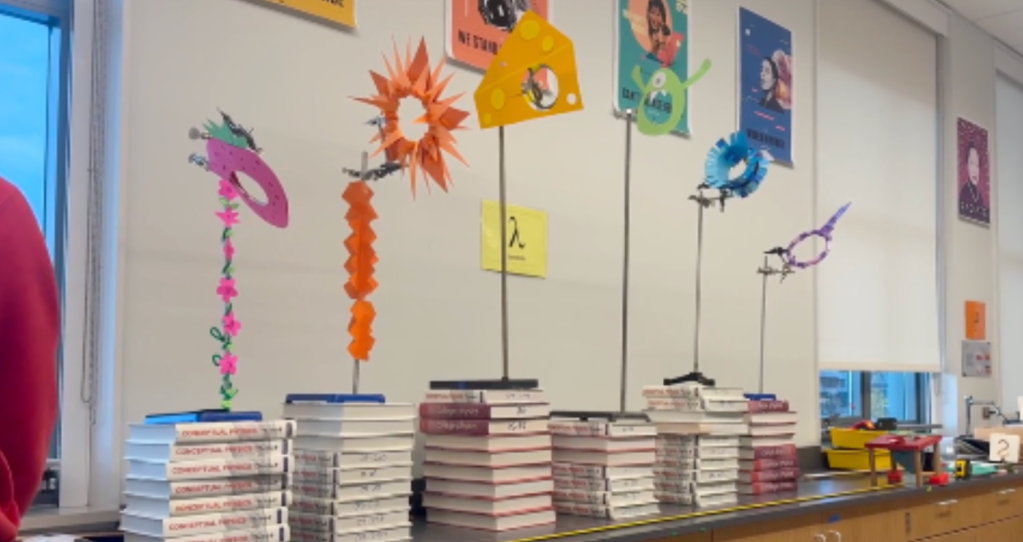
Objective: A daredevil is shot out of a cannon and lands in a basket at the same height they started. Place rings of fire along their trajectory at the correct height and angle. Then, determine where the basket should be. Problem written by Michael Freeman, https://bit.ly/RingsOfFire.
FAQs
What is a Live Action Problem?
Any textbook-type problem whose answer can be verified live. The goal is to bring problems off the page and into real life.
Unlike a lab practical, which in our opinion is more focused on data collection and analysis skills, the Live Action Problem has more quick-and-dirty data collection. The focus is on problem-solving.
How do we choose Live Action Problems?
We’ve had success with these approaches:
- Scour a textbook for problems, like the Equilibrium Station.
- Collide objects moving two different types of motion, like The Wrecking Crew. Great review, too!
- Overlay a story on a traditional lab practical, like Coyote vs. Road Runner.
What advice do we have for designing the assignment?
- Scaffold the assignment so the best answers use multiple & standard representations (such as free body diagrams). Ideally, the whole problem is solved on paper before moving to data collection, too.
- Assign students to a group and require one submission from each group.
- Write the problem so it can be solved and tested in a single class period. Otherwise, you risk cross-pollinating.
- Need to buy more time for students to think about the problem? Consider asking the textbook version of the problem on a written test, given the day before the Live Action Problem Day.
- No new lab techniques or tools. Unlike an experiment or lab practicum, the Live Action Problem isn’t an assessment of lab skills. It’s a problem-solving activity.
What makes a Live Action Problem a high quality assessment?
- Better academic integrity, unlike a lab report written outside of class.
- Immediate feedback because the prediction gets tested in class.
- The assessment is aligned to both content and process standards.
 Megan Hayes-Golding