On the occasion of the induction of class of 2025 students at my school, I was asked to speak on learning.
Good evening and welcome to the Cum Laude dinner! Students, congratulations on getting here. Faculty, thank you for being here to share this moment of joy with these great young people. Thank you to the Cum Laude Society for asking me to speak tonight, I’m honored.
My mom’s best friend who’s also my favorite kindergarten teacher, used to say “Kiss your brain!” whenever her students had a breakthrough. It’s age appropriate for 5 year olds, maybe a little silly for big kids like y’all. Nonetheless, in my ninth grade classes, students metaphorically “kiss their brains” after they struggle with confusing ideas – like how to describe the changing rate of change for an object that’s speeding up. They’re learning how to handle their own confusion. Of course, social pressures make it tough to be wrong, school “counts” now, expectations are higher than at their last school – whatever the reason, your teachers realize it’s tough AND vital to lean in on confusion. Watching you enjoy the dopamine hit you get from accomplishing something difficult is absolutely my second best repayment for being your teacher (nothing beats Swedish Fish).
Think about a particularly memorable time you figured something tough out. Did it go anything like this?
Nah, not quite? Maybe Eureka! is the Hollywood version of “Kiss your Brain.”
What I remember from every project worth my effort is feeling like I’d never figure it out, right up until I did (figure it out).

Source: https://personalexcellence.co/blog/emotional-journey-creating-infographic/
Welcome to The Emotional Journey of Creating Anything Great! This graphic helps me stay grounded when working on difficult projects. I like remind myself that the rollercoaster of emotions I’m going through is totally normal and typical. New projects start with enthusiasm, “This is the best idea ever!!”. Once I get rolling, I quickly move from “This will be fun” to “This is harder than I thought”. My enthusiasm is waning and is replaced by confusion. I don’t know what to do. I don’t know how to solve this problem. I’m a dummy. I’ve arrived to the pit of despair. (Gen X’ers, is it just me or does this sound like The Neverending Story’s Swamp of Sadness?)
How’d I get stuck? Well, I think it’s because worthy projects take way more effort than I ever predict, many of our first ideas won’t pan out, and I’ve stopped seeing progress. Also, I’m confused because the task is a bit too challenging. In your case, next time you work on a tough project, you might use some skills you picked up right here at Deerfield to pull yourself through. Maybe you’ve taken a computer science course where you learned problem decomposition – breaking big problems into smaller ones. Or a history class that taught you how a rough first draft can get you past writer’s block. Maybe there was an art class that taught you how to practice iteration. But when you think about it, isn’t each of these a way to make sense out of confusion? I tell my 9th graders that if they’re not confused, they’re not learning. Think about it – grinding out a bunch of work without too much effort is busy work. You’re not learning anything from the experience. It’s the stuff you’re confused about, that you have to think about, that really gives you new insight.
Back to the Emotional Journey, one insight leads to another. Finally! There’s progress, I’m coming up out of the pit. “Hmmm” turns to “Hey!” turns to “Wow”. Holy cow, I made it! “Kiss your brain!” Whenever I’m mired in a project, this picture pops into my head. It’s my signal to pause and figure out where I am on the journey. Then I ask what I need to move to the next step. Because I know there’s always a next step.
By the way, you’ll notice I’ve called projects worthy. A worthy project is one that hits me with the right balance of difficulty and skill level. If you can find work with just the right amount of difficulty to match your skill level, you will feel engaged. In the zone. You’ve entered the flow state.
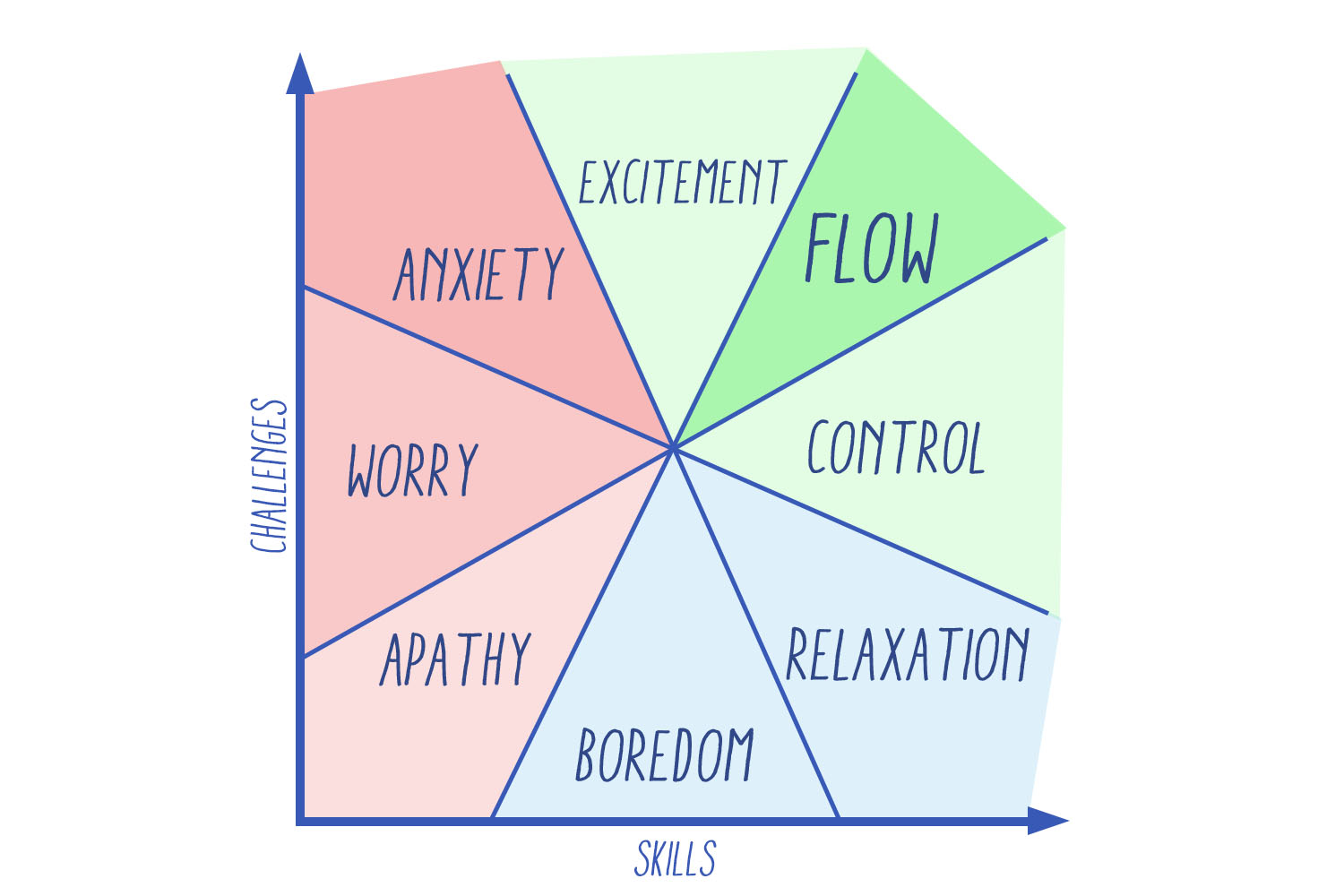
What is flow and how can it make you happy, though? Psychologist Mihaly Csikszentmihalyi sought the source of happiness and concluded it’s an internal state we can cultivate. He interviewed athletes, artists, and scientists who consistently said they were their most creative, productive, and happy when they were in a state of flow. I first heard of flow from his 2004 TED Talk – which I wholeheartedly recommend. He asked us to place our skills and the challenge of a task on two axes, as so. Then, he plotted emotional zones on the graph. Here, where skills are low and challenge is high, for instance – what might that make you feel like? How about here where skills are moderate but challenge is low?

Here’s the whole graph Csiksentmihalyi created.
Source: Source: https://trainingcenter.acgov.org/2019/08/flow-state/
There are eight zones of emotional state located at the intersection of skills and challenge. I recommend using this chart to help find your way into flow. Feeling anxious or worried? That’s a signal that you’re in the red zone – time to increase your skills. Maybe that’s a consultation with a peer, a visit to extra help, or expanding your reading. Are you feeling bored? You’re in the blue zone. You need a more challenging task. Side note: I’m not saying that all tasks deserve to flow state levels of concentration. Sometimes you just gotta grind through the math homework, know what I mean? I’ve noticed that I tend to enter flow from here, Excitement. This is the high side of the challenge axis, meaning I’m probably feeling confused, because my skills are just a tiny bit too low. From here, though, I can slide in to flow. I get “locked in” on a worthy task, losing my sense of time and am fully focused on the task. And that, my friends, is how it gets to be 1am after you “just” sat down at 7:30pm to start.
Now, flow is really interesting. First, when you’re in it, you have complete focus. Time dilates and the work feels effortless even though it’s also challenging. Second, flow comes when you’re working on a task of just the right difficulty and your skills are relatively high.
Researchers are just beginning to understand what happens in the brain during flow. They’ve discovered that brains in flow block irrelevant activity, which seems to free up more brainpower for the task. This inhibition, as it’s called, actually prevents you from feeling distracting sensations or thoughts. It explains, for example, why when you’re totally locked in you might not feel fatigued or hungry. We know also that getting into flow takes practice. And that being knocked out of flow makes it tough to find your way back.
So, next time you’re working on a challenging problem, I hope you’ll use feelings to find your way to flow, use confusion to up your skill, and recognize that all great creations require an emotional journey. When you do, you’ll be able to “kiss your brain!” just like Ms. Shattuck, my favorite kindergarten teacher taught me.

Linda Eliason (my mom!) and Chris Shattuck (aka, my favorite kindergarten teacher and source of “Kiss Your Brain!”), both of blessed memory.
 Megan Hayes-Golding