The following question has proven fantastic at assessing how much students understand the idea of modeling in physics class. Unlike most other test questions I might write, this separates those who understand what it means to make assumptions in applying models from those who crank out solutions to equations.
A 3 kg block is dropped off the roof of a building that’s 25 meters tall. The block hits the ground 3 seconds after being released. Was air resistance a significant factor in this block’s motion?
I’ve lightly scaffolded the space for answers as follows:
Start with your answer to the question: air resistance __________ a significant factor in this block’s motion. (is or is not)
Justify your answer. Substantial responses will provide evidence and reasoning to support the claim. Complete answers mix multiple representations (verbal, mathematical, and pictorial).
A gallery of student work follows. In short, students went a few different directions: 1) understood that they needed to show the acceleration is or is not -9.8 m/s/s, 2) halfway understood what the first student did, 3) used circular reasoning to conclude a=-9.8m/s/s by first assuming a=-9.8 ms/s/s, and 4) understood the question but algebra & physics got in the way. That last one was the most interesting to me and is pictured last in the gallery:


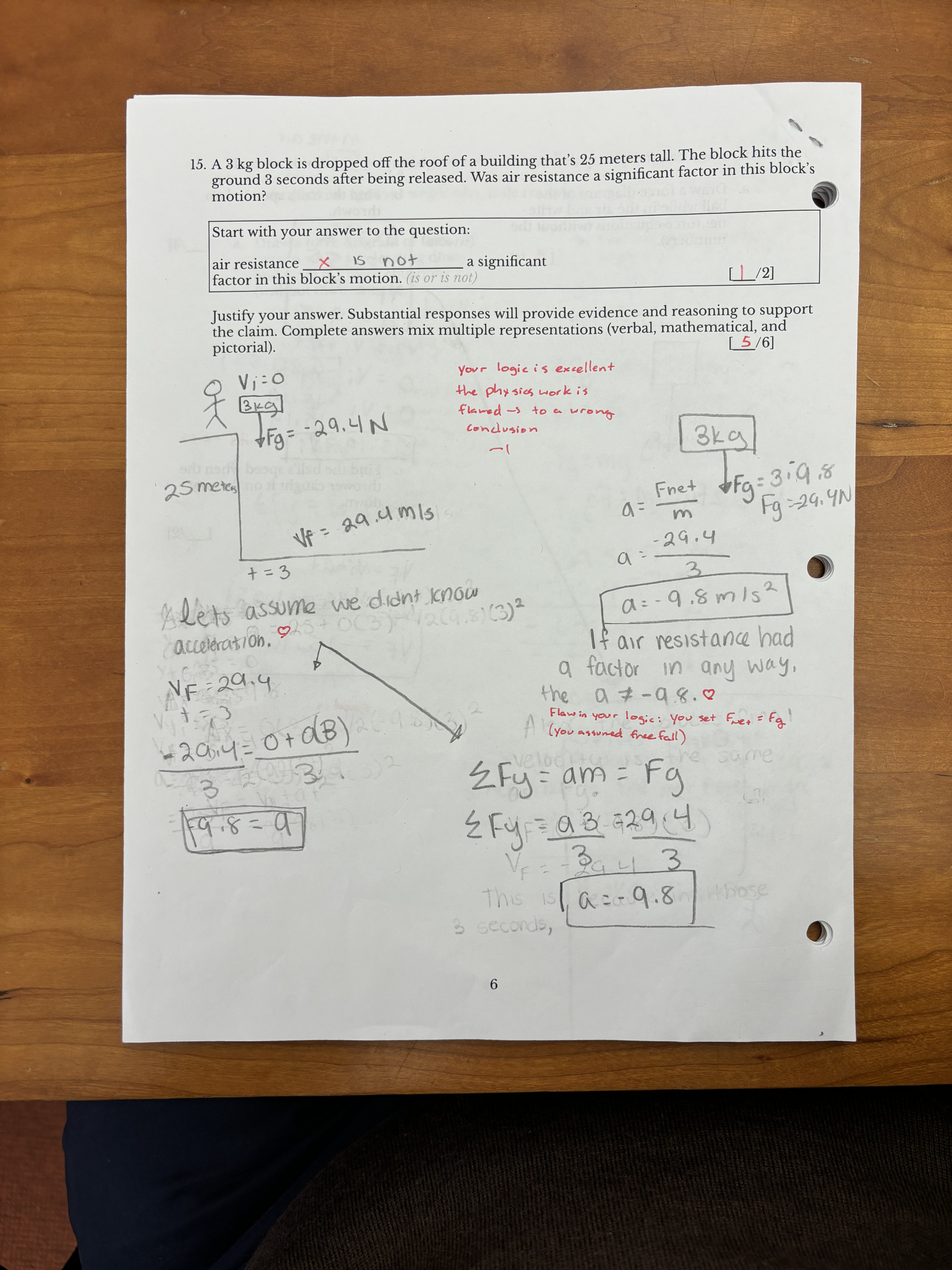
Several other circular logic answers said things like “the block is falling really fast, must be free fall” and “air resistance is not significant when an object is in free fall”. These kids don’t understand what it means to present evidence.
A point of growth for me is to return to an older practice of mine where at the end of developing a model, we examine problems that break the model. So, at the end of learning to model motion as free fall, we would look at problems just like this one, asking “is it in free fall?”
 Megan Hayes-Golding
You are such a wonderful teacher! I love how you identify areas of growth for yourself as well, not just your students. Miss you!