Today’s story references The Mystery Box, a portion of a popular lab practical I copied from Kelly O’Shea’s Puzzle Box. The Mystery Box has helped me understand how a well-designed assignment can encourage students to do fantastic thinking with less scaffolding.
The context is an on-level 9th grade Physics course. The assignment is completed at the end of the year.
The Mystery Box’s explicit goals: Given a mystery circuit with 3 bulbs and 2 switches, organize your observations then use them to inform your drawing of a circuit diagram. Students were equally accountable for observations and the accuracy of the circuit diagram. The instructions asked for “Observations based on interacting with the box (being complete and accurate matters)”.
The implicit goal: I wanted students to be thoughtful about how they organized the data without telling them exactly what to do. When asked for detail, I used phrases like “space efficient” and “reference-able data.” For the students who created brilliant observation summaries, the mystery was easy to solve. For those who made bulleted lists heavy on words, solving the mystery required them to lean on trial and error or their often larger-than-average working memory.
To support the implicit goal, I weighted scoring on the observations and the circuit diagram sections equally but chose not to ask for an explanation. I wanted the assignment to be quick to grade and I struggled to imagine a brief explanation that added richness to the student’s work. I’m no longer as convinced of this, so I may require an explanation next year.
Also, I spent forever designing a circuit that forced disciplined data collection and study. Options I considered but rejected include limiting time students have to experiment with the actual box, building a harder mystery, and requiring the explanation.
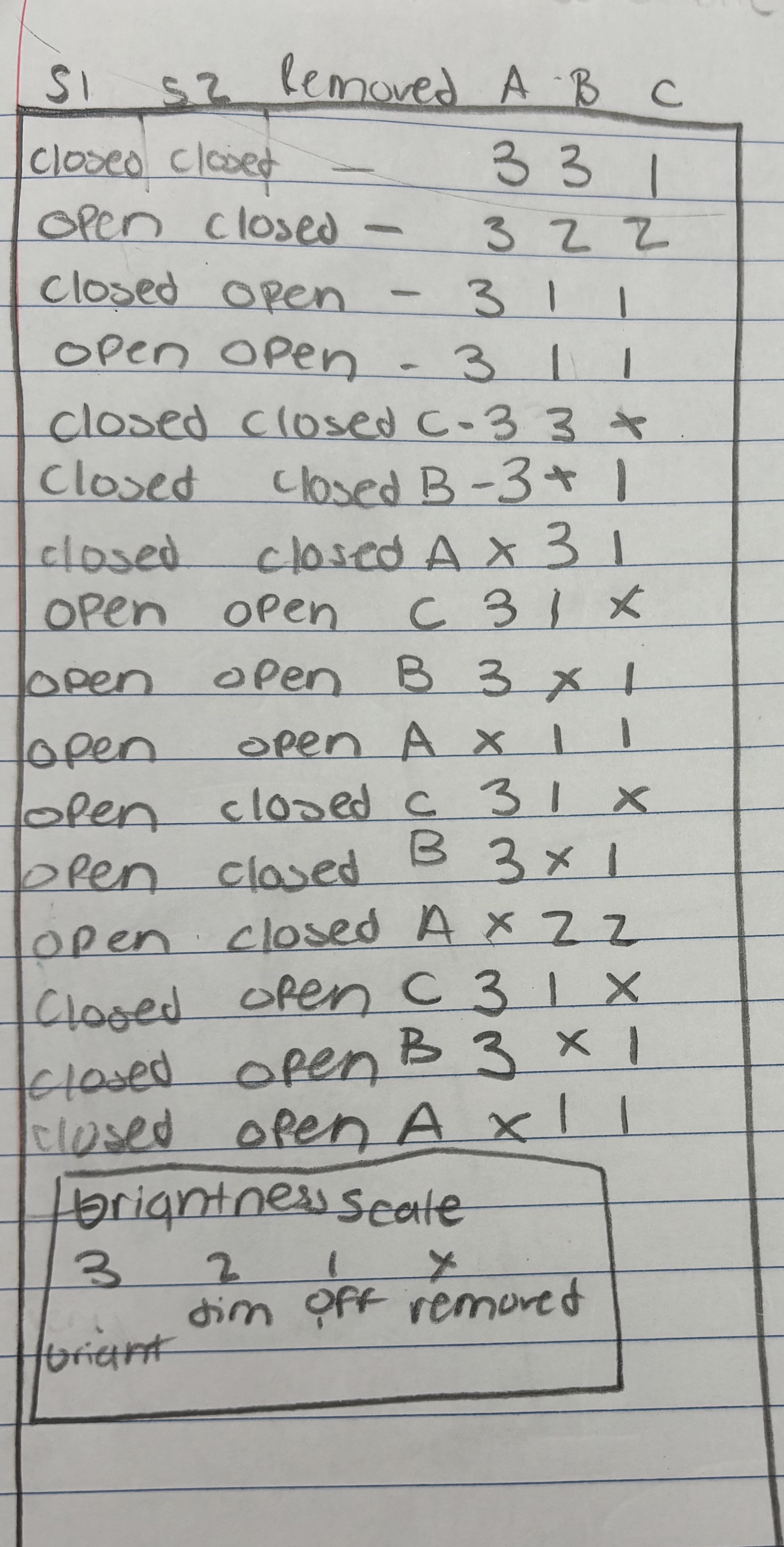
One student who embraced the challenge of the implicit goal was M. She encoded every circuit state as a row with 5 columns (one for each of the 2 switches and 3 bulbs). She made up a brightness scale, solving a huge problem many had with their tables that reported only on/off observations. Brightness observations were crucial to solving the mystery.
M’s data table didn’t come easy—she initially struggled with the open expectation. What did “observations based on interacting with the box” mean? How would she fit all the observations all in the small space I provided? M, with my encouragement, found it helpful to draft ideas on a whiteboard before committing to the final version she handed in (and pictured at right).
I see now that this assignment was effective at forcing M to do the right thing because it helped her solve the problem, not just because I would be grading it.
When writing tasks with implicit goals, I think it’s helpful to hold these four criteria in mind:
- Teachers must fade scaffolding to encourage independent thinking. Timing this well in the learning cycle is critical.
- Students choose to use the representations of a physicist/scientist because they’re the most efficient/effective, not merely because the teacher wants them.
- Student solutions require referencing written data, not working memory.
- Where appropriate, students feel they must finish collecting data before they begin hypothesis testing.
I think what surprised me the most in this story was that it’s possible to see constraints on working memory as a feature, not a bug. Intentionally fading scaffolding is the one I find most challenging to implement.
Like what you see here? Then you might also enjoy the original post, which focused on writing a task to meet explicit goals.
 Megan Hayes-Golding